

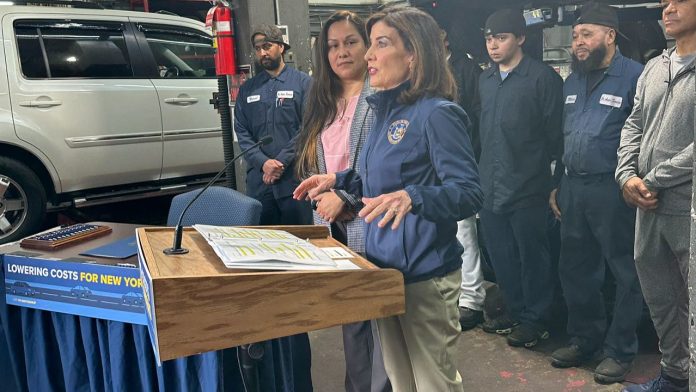

Just over a month after Gov. Kathy Hochul and state lawmakers passed changes to the state’s car insurance laws as part of a tardy and contentious budget process, Hochul is instructing insurance companies to demonstrate how they are factoring the slate of initiatives into their rate-setting process.
The auto insurance law changes were billed as a cornerstone of Hochul’s affordability agenda, but whether they would ultimately be successful in lowering rates was a key point of contention that helped bog down negotiations. Auto insurance discussions ultimately made up a sizable portion of the nearly two-month delay in passing the latest state budget in 16 years.
Hochul’s plan focused largely on cracking down on insurance fraud driven by staged crashes, while the state Legislature expressed concern that the governor’s proposal could make it more difficult for individuals injured in an accident to seek damages and that her proposal did not guarantee insurance companies would pass along any savings.
Insurance companies have largely been supportive of the overall initiative and Hochul’s targeting of fraud.
The governor’s office said the guidance, issued through the state Department of Financial Services, is intended to create guardrails to ensure companires do by requiring applications to change rates to reflect the impact of the new regulations in all pending filings by Aug. 31 and in all future motor vehicle insurance rate filings.
“Since taking office, I have been committed to making New York safer and more affordable, and that includes driving down the cost of auto insurance,” Hochul said. “For most New Yorkers, driving is a necessity to get to school, work or run daily errands, and it’s imperative that we ensure these savings are passed down to hardworking families.”
Companies are expected to factor in the following changes, according to Hochul’s team:
- Expanded Definition of “Fraudulent Insurance Act”: Prosecutors are now able to seek criminal penalties against all individuals responsible for organizing or facilitating a staged accident, not just the individual behind the wheel.
- Limiting Damages for Individuals Engaging in Unlawful Behavior at the Time of an Accident: Damages are capped for drivers engaging in criminal behavior at the time of an accident to ensure drivers who violate the law, including uninsured motorists, drunk drivers and drivers in the act of committing a felony, do not receive disproportionate financial recoveries at the expense of policyholders.
- Tightening the Serious Injury Threshold: The enacted budget modifies the definition of “serious injury” so damages for pain and suffering or emotional distress are reserved for those able to objectively demonstrate they have suffered serious injuries.
- Limiting Damages for Individuals Who Are “Mostly” At Fault in Causing an Accident: Drivers found to be primarily responsible for causing an accident are now unable to sue other parties for outsized damage payments. This change puts New York in line with most other states.
- Updates to Approval Authority Over Auto Insurers’ Rates: New limits have been put in place requiring companies to seek express prior approval from DFS before any upward rate changes.
Kaitlin Asrow, acting superintendent of the New York State Department of Financial Services, told Spectrum News 1 that in order to ensure the reforms are properly implemented and passed on to ratepayers, insurance companies that don’t show their work will have their rate setting requests declined.
“It’s giving direction to auto insurance carriers to incorporate the projections of savings from these reforms into their current rate filings before us and any future rate filings, and we’re indicating to them if they don’t incorporate those projections, then we will deny their request for rate,” she said.
Asrow said the resulting process will be a combination of reporting by the insurance companies and a compliance check by the department before any increases are approved.
“The carriers have the most direct data in terms of actual claims, the actual expenses day in and day out for all experiences across the state, so the key is for them to make that first pass,” she said. “Our actuaries are going to do a rigorous review to make sure it complies with what we expect and state law.”
State Assemblymember Jen Lunsford was outspoken in her concern that the governor’s initial proposal did not adequately balance the risk of unintended consequences stemming from limiting damages for some individuals and altering injury thresholds with a guarantee that rates would drop.
“We needed to do more to rein in insurance companies to make sure that if people were going to lose access to lawsuits, that we were going to be able to deliver real results, so that was the goal as we were going through these negotiations,” she said.
Lunsford argued that because there are limited ways the state can address car insurance rates, with so much of it dependent on things out of lawmakers’ control, like the cost of auto repairs and supply chain issues, it didn’t make sense not to take advantage of any legislative avenue available to press insurance companies to pass savings along.
“The little bit we could whittle down along the sides, that had to involve dealing with the way insurance companies write our plans, set our rates and ultimately collect profits off our premiums,” she said.
That said, she thinks what she described as an uneasy compromise will have benefits for ratepayers.
“What we got I think will ultimately deliver savings to New Yorkers,” she said.
As for whether the changes will actually result in savings for New Yorkers, Hochul and state lawmakers have predicted something in the neighborhood of a 10% decrease, which will likely take about two years to materialize.
One of Hochul’s key negotiating strategies was pointing to positive outcomes in other states that have implemented similar changes. Sean Campion, director of housing and economic development studies at the Citizens Budget Commission, said that across the spectrum of potential reforms, examples from other states like Florida and Michigan do point to a decrease in rates.
“Addressing the root causes of their high costs saw reductions of 10 to 20 percent,” he said. “We’d expect that to go through in New York too, and that’s real money. A 10% reduction in premiums in New York will save New York drivers and businesses about $2 billion total. That’s about $200 per car per year.”

Based in New York, Stephen Freeman is a Senior Editor at Trending Insurance News. Previously he has worked for Forbes and The Huffington Post. Steven is a graduate of Risk Management at the University of New York.