


Toni Symons has lived on volcanic Hawaiʻi Island for nearly 50 years. She is used to earthquakes.
“That’s just part of living here … and you know, they’re usually just a jolt,” she said.
But the earthquake that rocked South Kona on the Friday night before the long Memorial Day weekend felt different. The 6.0 magnitude event struck close to 10 p.m. on May 22, after Symons had turned in for the night. As she lay in bed with her husband, listening to the sound of glass shattering throughout her house, she wondered when it would be over.
“You’re laying there going, is this going to end? I had never experienced a long shaker like that before … It was so scary,” she told HPR.
Bracing for aftershocks, Symons tried to put aside her fear — she had work to do. She is the West Hawaiʻi director for Vibrant Hawaiʻi, a community organization that has set up resilience hubs across the island and become a crucial partner to county agencies during disasters.
Symons said almost immediately, people from the organization’s different hubs started messaging each other, trying to get a sense of the impacts of the quake.
By the next morning, Vibrant Hawaiʻi had retooled a community needs assessment form that they had developed during the recent Kona Lows. It was released alongside Hawaiʻi County Civil Defense Agency’s official damage report forms.

In the days since the quake, Vibrant Hawaiʻi has received about 80 responses. Symons said one of the top requests was for assistance repairing or replacing water tanks.
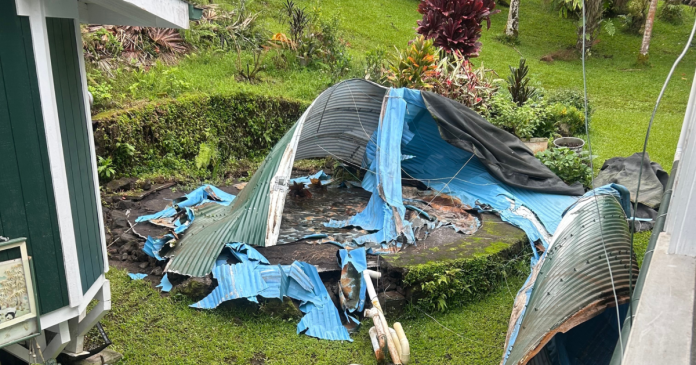
Many residents and farmers that live on Maunaloa’s steep slopes rely on rainwater catchment systems since they are not connected to county water. The recent earthquake exacted a particularly devastating toll on these systems.
Mark Takizawa has been farming coffee on a dozen acres in Hōnaunau since 1986. He lost one of his water tanks during the earthquake.
“That shaking was too much for it, and it literally just burst like a balloon,” he said.
Another tank connected to Takizawa’s main house sustained only minor damage. He was able to quickly repair it after the quake and maintain more or less normal water access. Others have resorted to filling up jugs and water totes at county spigots and hauling them back to their properties.
Coffee farmer KayLynne Santana has been relying on a temporary water system since the earthquake took out her two water tanks. The 71-year-old and her 80-year-old husband drive a few miles to the nearest spigot to fill up a 275 gallon water tote, which lasts them about three days.
Residents await federal assistance
Santana said the companies that install and repair water tanks in her area are backlogged with orders, so it is unclear when her normal water access will be restored. In the meantime, she and her husband, who are both on fixed incomes, hope that federal funds will be made available to help South Kona residents to help with costs.

Earthquake insurance is not required by state law in Hawaiʻi, and standard homeowners and commercial property insurance policies typically do not cover earthquake damage, according to the state’s Insurance Division.
The USDA’s Emergency Conservation Program offered some relief for farmers in the wake of the recent Kona Low storms, but has yet to open the program for farmers who need assistance after the earthquake.
Acting Director Keadin Fujii told HPR that he and his colleagues are “currently working on getting approval to open the program in the next few weeks.” ECP can cover costs on a narrow range of “conservation structures,” such as dams and irrigation pipelines. Water tanks may fall in that category.
Civil Defense has received more than 400 damage reports since the earthquake. This week, county officers are sifting through to identify where the damage is most severe and conducting site visits.
“We’re trying to establish that there’s sufficient damage in the community that this requires the assistance of the federal government,” said Adam Weintraub, a staff officer with Civil Defense.
Symons, with Vibrant Hawaiʻi, said she has had questions from residents about whether they should complete damage reports for unpermitted structures.
“That’s a big concern for all of us,” Santana said. She noted that like many of her neighbors, she had several unpermitted buildings on her property.
Weintraub said that is not a concern for Civil Defense at this point.
“Nobody’s out there checking the permit status of your property this week, and it’s not something that we consider when we’re assessing disaster assistance,” he said.

Civil Defense will use documentation from this week’s site visits to make the case that FEMA and the Small Business Administration need to step in.
Aside from her water tanks, Santana said that the retaining rock walls along her sloping property bore the brunt of the earthquake. She anticipates it will cost between $40,000 to $50,000 for repairs.
Santana has already had to repair these rock walls once, after a 6.7 magnitude earthquake struck Hawaiʻi Island in 2006. At the time, she and her husband took out a low-interest loan from the Small Business Administration to help cover the expense.
Twenty years later, they have yet to pay off that original loan. Now, Santana thinks she may have to take out a second SBA loan to pay for the recent damages.
“We know it’s going to be so costly to do,” she said. “We’re just waiting to see if something comes of help towards getting it done.”

Alice J. Roden started working for Trending Insurance News at the end of 2021. Alice grew up in Salt Lake City, UT. A writer with a vast insurance industry background Alice has help with several of the biggest insurance companies. Before joining Trending Insurance News, Alice briefly worked as a freelance journalist for several radio stations. She covers home, renters and other property insurance stories.