
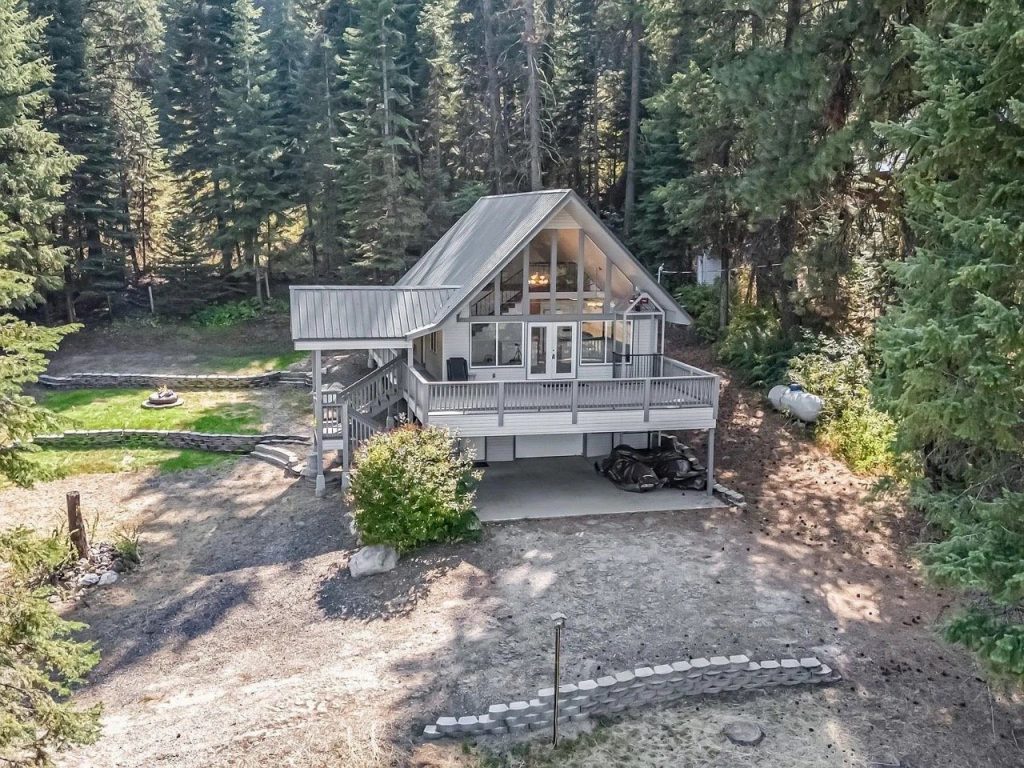
Wava Kaufman was worried the cabin she had long dreamed of was about to slip through her fingers.
After a decade of studying real estate listings and saving, Kaufman and her husband found the perfect cabin of their Idaho retirement dreams near Smiths Ferry in Valley County. They were in the final days before closing on the cabin in October, when they were down to the wire on whether they could secure homeowners insurance to buy the property.
Their insurance broker tried several companies, including one that would only issue a policy for the cabin if several trees were removed before the property closed. Kaufman ended up signing up for a policy at the last minute to ensure they could buy the property, but it cost roughly $6,000 per year to insure the 1970s-era cabin. She did not specifically note which carrier was providing the insurance at the time because she was so relieved to have found coverage.
She said $1,000 of this cost is due to a small outhouse on the property, which the insurance company counts as an outbuilding. Kaufman and her husband soon plan to demolish it to see if that brings their insurance premium down after she said the company wasn’t satisfied with their proposal to install automatic sprinklers to protect the house. They’re also in negotiations to be annexed into a nearby fire district, so the insurance company has proof of which of the closest stations would respond in case of an emergency.
“It’s a nightmare because if you think of the average Idahoan, I almost can’t buy a cabin here because I can’t afford the stupid fire insurance,” Kaufman told BoiseDev. “It’s outrageous. I think it’s a huge ripoff that they’re charging us this much money and won’t give anybody fire insurance. That’s pretty crappy that they’re making $6,000 a year off of us.”

The Kaufmans are far from alone. New data compiled by the Idaho Department of Insurance and first reported by Boise State Public Radio shows thousands of policy cancellations statewide since 2022, as well as double- and sometimes triple-digit increases in homeowners insurance premiums to keep their policies. The difficulty in finding homeowners insurance coverage puts financial pressure on homeowners with mortgages who are required to insure their homes and those with paid-off properties who worry they won’t have any coverage if they lose their home in a fire.
This comes as homeowners insurance policies have been dropped and rates hiked nationwide due to the impacts of a range of disasters, including sea level rise, more frequent, stronger hurricanes, and deadly wildfires worsened by climate change. A 2023 study by the U.S. Senate Committee on the Budget called the increase in canceled policies a “climate change-fueled insurance crisis.” The study ranked Boise County 87th in the nation for the highest homeowners insurance non-renewal rate.
The data collected by the Idaho Department of Insurance shows that although rural areas of the state are paying some of the highest premiums, it’s Idaho’s urban areas with the highest amount of losses paid out to customers. Wildfire remains a small fraction of what causes home losses in the state, but it has steadily increased from 2022 to 2024. Industry professionals argue that tightening requirements for homeowners insurance policies is necessary to keep companies financially stable enough to cover the possibility of a catastrophic loss in Idaho.
The Idaho Legislature heard bills that would study the problem of the Gem State’s insurance market and provide funds for homeowners to mitigate their risk during the 2025 legislative session, but neither idea made it out of the House Business Committee. On Thursday, Rep. Mark Sauter, R-Sandpoint, introduced a bill that would double the notice companies are required to give homeowners before canceling their policies, from 30 days to 60 days.
Sauter’s bill has not yet been scheduled for a public hearing before the House Business Committee, and it is unknown whether other legislative proposals on the issue will be introduced.
What does the data show?
Homeowners insurance is not only harder to get, but it’s more expensive, too.
According to the data from recent years collected by the Idaho Department of Insurance, the statewide average premium for homeowners insurance rose from $1,308 in 2022 to $1,798 in 2024. This is a 37% spike in rates statewide in a two-year period, which also saw tens of thousands of canceled policies across the state. The total number of home insurance policies in Idaho dropped from 464,364 in 2022 to 424,113 in 2023. The number of policies rebounded slightly in 2024 to 425,562, which leaves tens of thousands of homes without insurance or using unlicensed carriers.
Without donors like you, this story would not exist.
Make a donation of any size here
Dean Cameron, the director of the Idaho Department of Insurance, said his agency first started noticing signs of an “unhealthy market” three years ago when insurance premiums began to spike, and companies no longer wanted to write or renew policies in certain areas of the state. He said, although Idaho is known for wildfires, it’s rare for the state to lose homes like in Colorado and California, so his agency is looking for solutions to shore up the market so residents can have the resources to make their homes more insurable.

“We do see that the market does ebb and flow, and we think the market hopefully is starting to improve,” he said. “The insurance industry was in a perfect storm since COVID. We had significant inflation issues that have occurred, which drives up costs, and that’s not just in Idaho alone. That’s nationwide. We’re trying to show them that the losses aren’t as significant and they are able to collect premiums.”
Despite cancellation concerns over wildfire risk, losses to fire still represent a small minority of claims in Idaho. The state saw roughly $16 million in fire-related losses in 2022, a fraction of the $360 million total of losses statewide. That number climbed to roughly $24 million in 2024, again only a fraction of the roughly $296 million in total statewide home losses.


Urban areas, like a West Boise zip code and another in Meridian, ranked the highest on the state’s list of zip codes with the most total losses for fire damage. But neither of these zip codes ranked in the top 20 zip codes for the highest average premiums in the state from 2022 through 2024. Three zip codes in Blaine County, including those in Sun Valley, Ketchum, and Hailey, ranked in the top five with average premiums ranging between $3,896 to $6,840 in 2024. Stanley also came in with some of the state’s highest home insurance premiums of $3,596 that year, which was a 45% hike over 2022’s average premium.
Valley County also had three localities on the state’s most expensive zip codes for home insurance premiums. Lake Fork, an unincorporated part of the county, and the cities of Donnelly and McCall all saw home insurance premium rates increase between 37% and 54% in the same two-year period. Homeowners in Lake Fork were paying an average of $2,823 per year in 2024, up from $1,921 two years previously.
Cameron said high premiums in expensive resort areas like Sun Valley were expected, but what surprised state officials was the explosion in rates in more urban areas like Canyon County. Huston, an unincorporated area near Caldwell’s wine country, saw a 335% average premium increase from $1,234 in 2022 to $5,374 two years later. Caldwell also saw a 112% increase from $1,296 to $2,751 in the same time period.
Two zip codes in Caldwell also topped the list for the most policies canceled in 2023, with almost 2,000 customers in the 83607 zip code alone getting a non-renewal notice that year. Another 1,010 customers got a non-renewal in the 83605 zip code. Nampa followed close behind with 1,890 non-renewals in the 83686 zip code that year alone.
Insurance agent: Market changes require ‘mindset shift’
Getting your property insured isn’t the easy guarantee it once was.
Charity Andersen, a McCall-based insurance agent, told BoiseDev & Valley Lookout that it’s become increasingly difficult for her to offer insurance coverage for homes in and around Valley County. She said it’s no longer a given that prospective homebuyers can insure the properties they’d like to buy, especially in rural areas.
Despite the extra financial strain on customers, Andersen said she supports insurance companies’ decisions after conducting wildfire surveys to encourage customers to make sure their properties are as fire-resistant as possible. She said this new environment requires a “mindset shift” to check out your insurance options before deciding to buy a property, instead of looking for coverage while you’re in the process of closing a deal, like buyers could in the past.


Andersen said she looks at proposals for subdivisions with hundreds of homes in Valley County with its small fire departments and worries developers aren’t taking the risk of wildfire seriously enough.
“I truly believe that they put these measures in place to protect me as an agent and to protect the customers, and one of the challenges with stuff like this up here is a lot of these developers come in here and start building these properties without thinking about the congestion of if a wildfire were to come through,” Andersen said. “Everybody’s in it for the instant gratification or some real estate agents say ‘I will make this deal, I will sell this house,’ but this propety has pine needles all over the place and the insurance company is feeling uncomfortable with it and I feel like people are wanting the instant gratifiication of stuff and not thinking about the issue as a whole.”
Insurance companies rely on wildfire risk modeling to determine what properties are insurable and what changes could be made to make them safer. Andersen and Cameron, the directors of the Idaho Department of Insurance, said this is because wildfire is different than other types of disasters in that the condition of your property, and that of your neighbors’, can make a big difference on if your home is lost or saved.
“I’ve had companies say to me as we’ve tried to convince them to stay in our state, ‘I know you haven’t had many fires, but you’re just one catastrophic event away from having an Oregon, Colorado or California devastating fire’ and they’re correct,” Cameron said. “That’s an understandable response.”
Valley Lookout Editor Drew Dodson contributed to the reporting of this story.


Alice J. Roden started working for Trending Insurance News at the end of 2021. Alice grew up in Salt Lake City, UT. A writer with a vast insurance industry background Alice has help with several of the biggest insurance companies. Before joining Trending Insurance News, Alice briefly worked as a freelance journalist for several radio stations. She covers home, renters and other property insurance stories.