

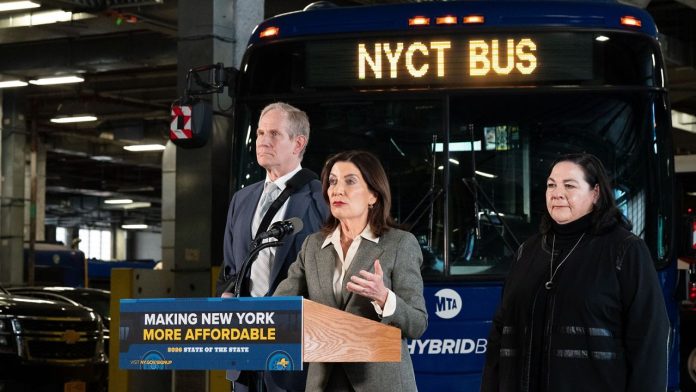
The MTA is getting on board with Hochul’s pitch to tackle car insurance rates.
“They can get a jury to say the MTA was 1% responsible — we’re responsible for the entire damages. And frequently, the other guys don’t even have insurance,” MTA Chair and CEO Janno Lieber said during a Harlem-based press conference Friday.
What You Need To Know
- Gov. Hochul is arguing that fraud and high payouts are making car insurance policies soar sky-high
- Opponents argue she’s listening too much to big companies spending money for the cause that stand to benefit, including the ride-sharing company Uber, and instead should use other methods to compel insurance companies to cut rates
- The MTA is getting on board with Hochul’s pitch to tackle car insurance rates, making the case that it’s the taxpayers who suffer when bus drivers are involved in crashes, but not totally at fault, yet the legal system decides the transit authority is on the hook for big bills
The transit authority made the case that it’s the taxpayers who suffer when bus drivers are involved in crashes, but not totally at fault, yet the legal system decides the MTA is on the hook for big bills.
“There was a case where an MTA bus was legally in the intersection, a guy blew through a stop sign, hit the MTA bus, bounced off, hit some passengers and somehow or other his lawyer convinced the jury that the MTA was 5% [responsible] and then had to pay, was on the hook, because the dude who blows the stop sign doesn’t have that much insurance and they’re on the hook for all the damages to bystanders and otherwise,” Lieber said.
The governor’s proposal tries to curb costs she says are associated with rising fraudulent claims, limit damages owed to uninsured crash victims and redefine what it means to be “seriously” injured in a crash.
One fiscal watchdog group estimates policyholders could save as much as $200 a year.
“Our rates are 32% higher than the national average, 12% higher than our neighbor in New Jersey and some of our laws are out of line,” Andrew Rein, executive director of the Citizens Budget Commission, said. “What the governor is proposing is to get in line with other states. We think it could save New Yorkers up to $2 billion, but really in individual New Yorkers’ pockets: $200 per car policy.”
Hochul’s also got the backing of Uber. The company already poured millions into a political action committee supporting the measure. But opponents argue the governor is listening to the wrong side.
“There’s an affordability crisis in New York that is a direct result of the governor allowing insurance companies to increase their premiums without justification. Her Department of Financial Services turned a blind eye and allowed insurance companies to jack up their premiums without support,” Andrew Finkelstein, president of the New York State Trial Lawyers Association, said.
“She is doing everything to protect the insurance companies by taking away New Yorker’s rights,” he added.
She also still needs to convince the legislature ahead of the state budget deadline on April 1. The Democratic-controlled chambers left the idea out of their own proposals.
“If there is fault on our part, there should be compensation. Of course, of course. We’re not talking about changing that. There should be fair compensation,” Hochul said, defending her idea. “I’d rather put millions of dollars back into the system where it belongs and to stop the bad actors from taking advantage of the system.”
Meanwhile, Hochul is also weighing new taxes on the wealthy to help the city fill its budget hole. She was asked if she feels more inclined to give in especially in light of a precarious prediction from the credit rating agency Moody’s.
“There are ongoing conversations. The specter of a downgrade certainly focuses the minds of the City Council members on what they need to do for the spending overall. They have time, they have months overall to work on the next budget. We have already provided substantial assistance to the city,” she said.

Based in New York, Stephen Freeman is a Senior Editor at Trending Insurance News. Previously he has worked for Forbes and The Huffington Post. Steven is a graduate of Risk Management at the University of New York.