

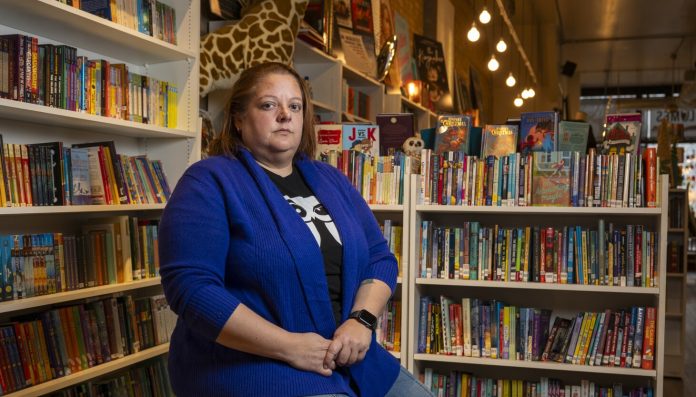

Rebecca George has had a cancel button looming over her for weeks.
The 45-year-old Chicagoan was automatically re-enrolled in a health insurance plan through the Affordable Care Act marketplace starting Jan. 1. But it would cost $796 a month — up from about $380 per month this year.
George plans to hit the “cancel coverage” button because she’s unsure if she will have any income next year. She’s in the process of closing up the Volumes Bookcafe she co-owns with her sister in Wicker Park by February.
“Unless I can find a way to save up $800,” said George, who was diagnosed with type 2 diabetes about a year ago. “I don’t know. I have other things to pay, too — rent, car insurance, food.”
George is among the more than 465,000 people in Illinois who depend on the Affordable Care Act, also commonly referred to as Obamacare, to buy health insurance.
For the last several years, the vast majority — about 85%, according to KFF — relied on enhanced federal tax credits to lower their premium costs. But those subsidies expire Dec. 31, and despite a push by Democrats, the U.S. House on Wednesday did not take a vote on extending them.
In a surprise move, four Republicans on Wednesday signed on with the Democrats to force a House vote on extending the subsidies for three years, but the earliest that could happen is January, according to the Associated Press. Passage of an extension in the new year with no adjustments is highly unlikely.
Without the enhanced subsidies one estimate is that 3.5 million Americans could go without health insurance, said Justin Markowski, an assistant professor of health policy at the University of Illinois Chicago. The number of people insured through Obamacare increased nationally from 11.4 million in 2020 to 24.3 million in 2025. The number grew as the enhanced tax credits, meant to curb the effects of the COVID-19 pandemic, made health plans more affordable.
“We’re going to have more uninsured individuals seeking care, and someone is going to have to pay the bill, whether that’s the hospital for giving that care through charity care or the individual through medical debt collection,” Markowski said. “But it’s going to strain the resources of our health care systems.”
Some people on the ACA don’t have access to employer-based insurance but may also not qualify for other programs like Medicaid or Medicare because of their age or income.
Even if people lose health insurance, Markowski encouraged Chicago-area residents to seek out federally qualified health centers and community clinics that continue to sometimes provide services on a sliding scale.
“We do have a fairly robust safety net in Illinois and Cook County and Chicago,” he said.
Illinois this week extended the deadline to enroll in the new state-run ACA to Dec. 31 for 2026 coverage. As of Wednesday, the state had not released early enrollment numbers.
One Chicago area couple, Seyed and Shahin, were still keeping tabs on talks in D.C. this week before enrolling in a health plan. This year, they paid $1,000 each month for a BlueCross BlueShield plan with an additional subsidy from the DuPage Health Coalition. They were bracing to pay double for a health plan. But health care for the retired couple is crucial especially as Shahin navigates serious health concerns like cancer.
“We are waiting for a few days,” Seyed said Wednesday about enrolling in a new plan. The couple asked that their last name be withheld because of privacy concerns.

Emily Been, outside her Edgewater apartment, says it will be a struggle to cover the $100 monthly increase in her health insurance premium. It’s the most affordable plan she could find.
Candace Dane Chambers/Sun-Times
In Edgewater on the North Side, Emily Been, 27, initially thought she would have to go without insurance after seeing her monthly premium of $150 increase to $400 next year. She can’t afford that price.
After some digging, she signed up for the cheapest health plan she could find on the state’s marketplace through the New York-based Oscar Health Insurance. She will pay about $250 a month next year, with a deductible of about $10,000.
“We live in a country where the threat of medical debt is very real, and there’s always the chance that you could get hit by a bus or something crazy could happen,” Been said. “… I just want to be insured so I don’t get buried in medical debt.”
The new premium will account for about 10% of Been’s monthly income as manager of a small restaurant. As it is, Been is usually stretching her budget to pay rent on a studio apartment and to pay off credit card debt built up during the pandemic while she was unemployed. There’s also the nearly $30,000 in student loans Been says she hasn’t been able to pay off.
“I’m probably going to have to make cuts on how much I dine out or just other little comforts that I am used to buying now,” said Been, who is hoping her small business employer may be able to provide insurance for her and her colleagues one day.

Rebecca George and her sister have owned Volumes Bookcafe in Wicker Park for 10 years. They plan it close it down by February.
Tyler Pasciak LaRiviere/Sun-Times
For George, the loss of insurance comes as she’s worked to manage a type 2 diabetes diagnosis for the past year. She has spent the past few weeks working with her doctor to figure out how she can continue medication she needs without insurance. She’s also sourcing ways to find cheaper glucose monitors.
The loss also comes as George closes up the bookstore she’s owned with her sister for about a decade. During that time, George often went without insurance because it was too expensive for themselves and their workers. She suspects the long hours and days also took a toll on her health.
It’s a struggle many other small business owners face, she said. Looking ahead, George said she’s seeking a job with health insurance. She sees no other way in the current political climate.
“If it’s up to them, [lawmakers] would dismantle the ACA altogether,” George said. “But there’s no option that they’re presenting that would replace it. No, I don’t have any faith in this Congress.

Based in New York, Stephen Freeman is a Senior Editor at Trending Insurance News. Previously he has worked for Forbes and The Huffington Post. Steven is a graduate of Risk Management at the University of New York.